
Information Theory Meets the Racetrack
In 1956, John L. Kelly Jr., a physicist at Bell Labs, published a paper titled A New Interpretation of Information Rate. It was not about gambling. Kelly was exploring how a bookie with noisy advance information about race outcomes should bet in order to maximize the long-run growth of his capital. The formula he derived — now called the Kelly criterion — quietly became one of the most important results in quantitative finance.
The idea escaped information theory because Ed Thorp, a Caltech mathematician, used it to beat blackjack in the early 1960s and then applied the same logic to markets through his hedge fund, Princeton Newport Partners. Warren Buffett, Bill Gross, and by multiple accounts Jim Simons' Medallion Fund have all used Kelly-like frameworks for sizing positions. The formula has outlasted fads because it rests on mathematics, not heuristics.
The Formula
For a binary bet with a known edge, the Kelly fraction is:
K = W − (1 − W) / R
Where W is the probability of winning and R is the payoff ratio — dollars gained per dollar risked. The output K is the fraction of capital to bet in order to maximize the expected logarithm of wealth. That is, the bet size that produces the highest long-term compound growth rate.
For continuous returns, the equivalent expression is K = μ / σ², where μ is the expected excess return and σ² is the variance of returns. This version underlies most quantitative portfolio-sizing models and connects Kelly directly to mean-variance portfolio theory.
A Worked Example
Suppose a momentum strategy has a 55% win rate and a 2:1 reward-to-risk ratio — every winning trade earns twice what a losing trade loses. Plugging into Kelly:
K = 0.55 − 0.45 / 2 = 0.55 − 0.225 = 0.325
The formula instructs you to risk 32.5% of your account on every trade. To any experienced trader this sounds suicidal — and for good reason. But it is worth understanding why the mathematics says 32.5% is optimal before explaining why no one actually trades there.
Why Full Kelly Is Theoretically Optimal
Kelly maximizes E[log(wealth)] — the expected logarithm of wealth — rather than expected wealth. The log transformation is essential. Compounding is multiplicative, and the logarithm converts multiplication into addition. Maximizing the expected log of returns is equivalent to maximizing the geometric mean return, which is the rate at which your account actually grows.
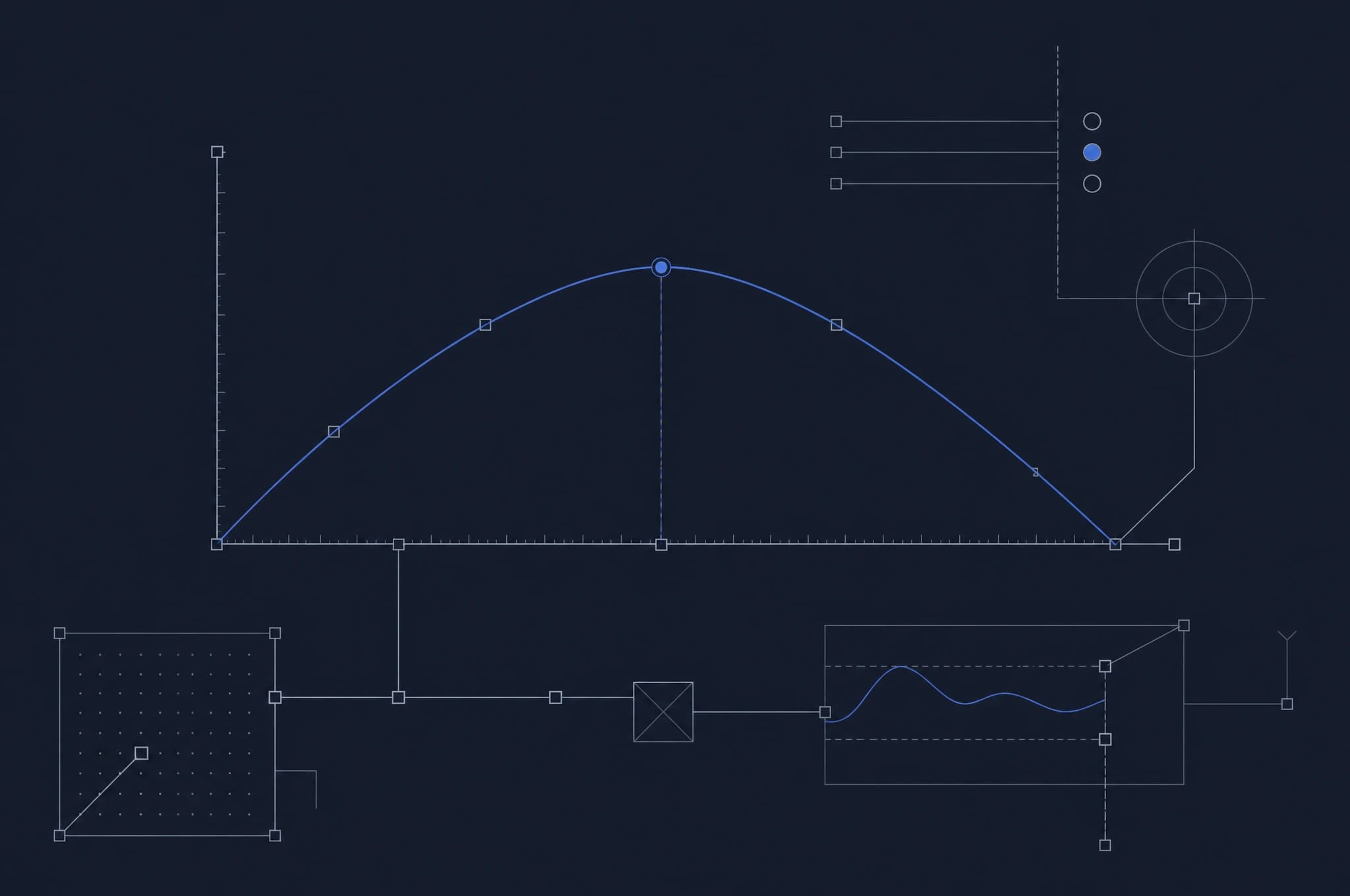
Betting more than Kelly reduces expected log growth. Far beyond Kelly, expected log growth turns negative: you are mathematically guaranteed to go broke over enough trials, even when every individual bet has positive expected value. Betting less than Kelly remains profitable but grows more slowly. The curve is sharply asymmetric — under-betting costs you growth, but over-betting costs you existence.
Why No Serious Trader Uses Full Kelly
The formula has a brutal sensitivity problem. It assumes you know your true win rate and payoff ratio exactly. In real trading, you estimate both from backtests, which are noisy, frequently overfit, and drawn from a market regime that may no longer exist.
Suppose you believe your edge is 55%/2:1 but the true edge is 52%/1.8:1. The true Kelly is about 0.25, while you are betting 0.325 — a 30% over-bet. Even small errors in edge estimation lead to systematic over-sizing, and at full Kelly the drawdowns are already ruinous. Monte Carlo simulations show that betting full Kelly on a genuinely winning system produces peak-to-trough drawdowns of roughly 40 to 50 percent as a matter of course.
The other killer is fat tails. Kelly assumes returns follow the distribution implied by your W and R. Markets do not. Tail events arrive far more frequently than any backtest predicts, and at full Kelly a single extreme loss can erase months of compound growth.
Fractional Kelly: The Real Standard
Because of estimation risk and fat tails, serious quantitative managers size at a fraction of Kelly. The tradeoffs are well studied:
- Half-Kelly: roughly 75% of full Kelly's expected growth rate, with approximately half the drawdown. Widely used as the "sleep well at night" compromise.
- Quarter-Kelly: about 45% of full growth, but drawdowns shrink dramatically. Institutional funds often size between 0.2× and 0.5× Kelly.
- 10–20% Kelly: used during regime transitions, on new strategies without long track records, or when correlation between positions is high.
Thorp himself ran Princeton Newport at between 0.25× and 0.5× Kelly — never full. The growth you give up is the price of surviving estimation error.
The Geometric Mean Trap
Many traders reason about position size using arithmetic returns, which quietly ignores volatility drag. If you lose 50%, you need to gain 100% to break even. If you alternate +50% and −50% trades, your capital compounds down by 25% every two trades rather than staying flat.
The relationship between arithmetic and geometric mean returns is approximately:
Geometric return ≈ Arithmetic return − σ² / 2
The variance penalty σ²/2 is the volatility drag. Larger position sizes inflate σ² quadratically, so doubling your bet size roughly quadruples the drag. This is the deep reason Kelly exists: it finds the size at which the growth from edge exactly balances the drag from volatility.
How to Estimate Your Edge Honestly
Applying Kelly requires honest inputs. Most retail traders overestimate their edge dramatically because they backtest on the same data they used to design the strategy — the classic in-sample overfitting problem.
- Use walk-forward validation: train on one window, test on the next, slide forward. Report out-of-sample win rate and payoff ratio, not in-sample.
- Assume your realized edge will be smaller than any backtest suggests. Transaction costs, slippage, and regime drift all eat edge.
- Recompute Kelly as new live trades arrive. A strategy's true W and R drift over time and must be re-estimated continuously.
- When in doubt, cut your estimated edge in half before applying the formula.
When Kelly Breaks Down
Kelly assumes a stationary distribution: the same W and R apply forever. Real markets are not stationary. Trend-following systems earn most of their return in a handful of regime shifts and grind out small losses in between. Mean-reversion systems work until volatility explodes. Full Kelly sized on trailing data will always be too aggressive heading into the regime change that invalidates the estimate.
Portfolio Kelly — sizing multiple correlated positions simultaneously — requires the full covariance matrix and is extremely sensitive to correlation estimates. In 2008, instruments that historically had 0.2 correlation spiked to 0.9 within weeks, and any portfolio Kelly model that did not explicitly account for correlation breakdown produced catastrophic over-betting.
The Practical Rule
Compute Kelly for each strategy using conservative estimates of W and R. Size at one quarter to one half of that number. Never size above full Kelly under any circumstances — the expected log growth curve falls off a cliff beyond 1.0. Recompute as you accumulate live evidence, and always expect your real edge to be smaller than your backtest implied.
Kelly is less a sizing formula than a framework for thinking. It forces you to quantify your edge, accept that the edge is uncertain, and size accordingly. Most trading failures are not failures of strategy — they are failures of position sizing. Kelly is the discipline that prevents a good strategy from killing you.
Sources & Further Reading
- John L. Kelly Jr., "A New Interpretation of Information Rate" (Bell System Technical Journal, 1956) — the original paper.
- Edward O. Thorp, The Kelly Criterion in Blackjack, Sports Betting, and the Stock Market (1997) — the definitive practitioner's guide from the man who did it.
- William Poundstone, Fortune's Formula (2005) — accessible history of Kelly from Bell Labs to Wall Street.
- L.M. Rotando & E.O. Thorp, "The Kelly Criterion and the Stock Market" (American Mathematical Monthly, 1992) — applies Kelly to long-term equity investing.
- Investopedia, "Money Management Using the Kelly Criterion" — introductory overview for retail traders.